We've moved! Please subscribe to the Google Marketing Platform blog for updates


Posted:
When we brought together DoubleClick and the Google Analytics 360 Suite under Google Marketing Platform, we knew we had to make some changes to our websites, blogs and social media channels too. Now, the resources you’ve been reading and visiting over the years have been updated to reflect our new brand, so you can find the latest news, tips and more on our advertising and analytics solutions in one spot.

First, you should know that we’ve moved our content and product information to marketingplatform.google.com. You’ll also find product sign-in links there. (Those bookmarks you have for the old DoubleClick and Google Analytics websites should automatically redirect you.)

We’ve also launched new and improved blogs, with information for our product users and enterprise customers. We’ll be regularly updating them with product news and digital marketing insights. Bookmark us.

Of course, you can also connect with Google Marketing Platform on social:
You’ll find customer stories, major product announcements, research, reports and other advertising and analytics content intended for large enterprises.

Thanks for following DoubleClick on this blog and on social over the years. We hope you like our new home!

Posted by Karen Budell
Content Marketing Manager, Google Marketing Platform

Posted:
Two weeks ago, we announced that we’re unifying our DoubleClick advertiser products and the Google Analytics 360 Suite under one brand: Google Marketing Platform. We also introduced Display & Video 360 as a key part of Google Marketing Platform. Display & Video 360 is a single, integrated product that helps creative, data and media teams work together to execute end-to-end ad campaigns.

Today, we’re sharing more about Display & Video 360, including how it helps marketers collaborate across teams, gain transparency and control over their investments, and use the latest advances in machine learning and automation to get better results. Read on to learn more, or watch the live stream from our Google Marketing Live event happening later today in San Jose, CA.

About Display & Video 360

Display & Video 360 brings together features from DoubleClick Bid Manager, Campaign Manager, Studio, and Audience Center in a single product.

So what does that mean?

First, Bid Manager will soon become Display & Video 360. This will happen automatically—customers won’t have to take any action and campaigns will continue to run uninterrupted. Second, Display & Video 360 is organized around five integrated modules that work together to simplify the end-to-end campaign process: Campaigns, Audiences, Creatives, Inventory and Insights.

These new modules reflect the fact that Display & Video 360 offers more than just Bid Manager’s programmatic capabilities. It also includes the campaign management, cross-platform measurement, creative and audience capabilities that are currently part of DoubleClick Campaign Manager, Studio and Audience Center. (Don’t worry, these products aren’t going anywhere right away—we’ll gradually transition customers of these products to Display & Video 360 in the future as additional features become available.)

By bringing these solutions together, Display & Video 360 enables marketers to fully manage their reservation, programmatic and programmatic guaranteed campaigns across display, video, TV, audio and other channels, all in one place. And using a single product to manage advertising campaigns and workflows end-to-end offers significant advantages compared to a more piecemeal approach.

Collaboration across teams

We know that getting a successful ad campaign up and running requires media, creative, data and analytics teams to work closely together along the whole journey. In fact, recent data from Google’s Media Lab—the team that manages all of Google's advertising campaigns—shows a 1.5X improvement in campaign performance when creative strategies and design are aligned to media, compared to when creative is built in a silo.1 But today, the typical digital campaign workflow is complex and manual, involving handoffs across multiple people, organizations and products—which makes it really hard to collaborate.

Display & Video 360 changes that. It helps teams share campaign data and insights at each step of the process, so they can work together to plan campaigns, design and manage creative, organize and create audience segments, find and transact inventory, then measure and optimize results.

“Running digital marketing for Major League Baseball is a unique opportunity because we cover all 30 MLB teams and a total of 2500 games each year. Display & Video 360 helps us to achieve the scale we need to meet this demand because it allows our creative, campaign management and analytics teams to collaborate really well. For example, our analytics team can share feedback on creative performance much faster than before, and then this feedback can easily be applied to many campaigns at once.”
-Barbara McHugh, SVP, Marketing, Major League Baseball

Transparency and control

With Display & Video 360 you can see precisely how your money is being spent and know exactly where your ads are running—across all of your campaigns. Understanding how your marketing is performing in real time gives you more control. You can quickly see what’s working and what’s not, and then make informed decisions to adjust your tactics and improve campaign performance.

Buying media through a single platform like Display & Video 360 also leads to better results—as measured in terms of both reach and efficiency. For example, Nielsen found that marketers who consolidated their traditional reservation deals with their programmatic guaranteed deals in a single buying platform increased their reach of unique consumers by an average of 11 percent—for the same investment in impressions.2 In another recent study, BCG found that programmatic guaranteed deals are 29 percent more efficient for agencies than traditional reservation deals measured in hours spent on deal set-up and management.3

“By consolidating all of our campaigns in Display & Video 360, we can easily control how many consumers we reach and how often we reach them. This means we don’t have to worry about wasted impressions or a bad consumer experience from people seeing our ads too many times. Instead, we can direct that investment to reach more of the people who are likely to fly with us.”
-Justyna Valente, Digital Marketing Manager, TAP Portugal

Faster, smarter marketing

According to a recent study of global marketing organizations by Bain & Company, speed in decision making separated the leaders—the top 20 percent of respondents based on revenue and market share growth—from the laggards, who represent the bottom 20 percent. Marketing laggards are 1.7X more likely to be held back by slow decision making4, while marketing leaders are using technology to surface trends and patterns in near-real time so they can deliver more relevant marketing with speed to assist consumers at the right moment.

Display & Video 360 takes advantage of Google’s unique capabilities in machine learning to automate tasks like bidding and optimization, so you can respond to users’ needs faster. Built-in intelligence across the product automatically surfaces insights and recommendations—such as where to shift budget to improve campaign performance—so you can act quickly to achieve your goals.

Tune in to learn more

Display & Video 360 will begin rolling out to all Bid Manager customers in late July. We’re excited to introduce this end-to-end advertising solution as part of Google Marketing Platform, and we’re eager to hear your feedback.

Please join me for the live streamed keynote at Google Marketing Live today at 9:00 a.m. PT / 12:00 p.m. ET or watch the recording after the event. I’ll be sharing more about Display & Video 360, including demos of some of the new features.

Posted by Payam Shodjai
Director, Product Management, Google Marketing Platform

1. Based on Q4'17-Q1'18 internal Google data.
2. Based on a Google-commissioned Nielsen study, May-Dec. 2017.
3. Based on a Google-commissioned BCG report, “A Guaranteed Opportunity in Programmatic Advertising,” July-Sept. 2017.
4. Bain/Google Marketing Leaders Study, Nov. 2017.

Posted:

Earlier this week we announced Google Marketing Platform, which brings together DoubleClick Digital Marketing and the Google Analytics 360 Suite into a single solution to plan, buy, measure and optimize customer experiences across channels and devices. But we all know having great technology is only part of the solution. You also need people with the expertise and knowledge to fully take advantage of everything the technology enables. It’s not unlike relying on Sherpas to help guide you from basecamp to the summit. You may be able to make the ascent on your own, but engaging a team of experts with a track record of success greatly improves your chances of making the summit. That’s why we’re excited to announce Google Marketing Platform Partners, a new program designed to ensure you have access to all the resources you need to get the most value from Google Marketing Platform.

A robust ecosystem of skilled practitioners and companies

More than just a replacement for the existing programs, Google Analytics Certified Partners and the DoubleClick Certified Marketing Partners, the new program is designed to provide a robust ecosystem of resources, no matter your needs. The foundation of the program is scaled training and capability-building across all the Google Marketing Platform products. Whether you’re looking to build skills in-house or partner with a service provider, the program helps ensure the needed skills and resources are readily available. With more than 500 companies in the program at launch, including leading interactive agencies, system integrators, and top technology, data and media companies, you’ll be able to find a partner to support multiple facets of your business.

Three unique designations

From skill-building to broader, strategic partnerships and technology reselling, the program is designed to deliver the range and quality of expertise you expect:

Certified Individuals: To help increase the talent pool available supporting the Google Marketing Platform, individuals will be able to access a growing library of self-study materials and complete individual product certifications. Successful completion signals an individual’s expertise with specific Google Marketing Platform products.
Certified Companies: Certified Companies provide consulting, training, implementation, operations and technical support services for Google Marketing Platform. These companies not only have individuals certified in one or more products, but they have a high level of knowledge, practical and industry experience, as well as stellar customer references. These strict requirements ensure they have both the expertise and a proven ability to deliver results.
Sales Partners: Sales Partners are Google Marketing Platform experts, just like Certified Companies, but partner more closely with Google in providing consulting and support services, in addition to selling the technology on our behalf.

Get started today

Whether you’re looking to add talent to your team, up-level your current talent, or complement your team with a partner company, Platform Partners offers a trusted source to help close the gaps. And we’ll continue to build out additional skill-building resources, refine our certifications and add new partners covering more countries and languages. To get started on taking your marketing to even greater heights, browse our current Partners to find a partner equipped to help you get the most from your investment in Google Marketing Platform.

Posted by Chip Hall
Managing Director, Media Platforms

Posted:
The online world was very different when DoubleClick debuted in 1996. Things we take for granted today, like texting emoji, sharing funny YouTube videos, or taking smartphone selfies were all years away.

Of course, changes in technology have meant changes for digital marketers. There’s been an explosion of channels, formats and data. Consumers are also more aware of how they’re being marketed to and how their data is being used—and they want more control.

To address these new realities, marketers need tools that make it easy to get better results from their marketing in a way that puts privacy first.

This is why we’re announcing Google Marketing Platform.
Google Marketing Platform brings together DoubleClick Digital Marketing and the Google Analytics 360 Suite to help you plan, buy, measure and optimize digital media and customer experiences in one place. Google Marketing Platform helps you deliver more relevant and effective marketing, while ensuring that you respect your customers’ privacy and give them control over their data.
In our recent survey of global marketing organizations, we learned that the #1 priority for marketers is to better understand their customers. By offering tools that make it easy to collaborate and share insights, Google Marketing Platform helps achieve this customer-first approach to marketing.

In the U.S., adidas has started working more collaboratively across their digital teams to share insights and get a deeper understanding of their customers. Chris Murphy, Head of Digital Experience, describes their approach:

“Our adidas teams work together in one environment where we can see audience insights, what creative we’re running and where, how it’s performing, and make changes almost in real time.”
Chris Murphy, Head of Digital Experience, adidas


Better results with ads plus analytics

Google Marketing Platform builds on existing integrations between the Google Analytics 360 Suite and DoubleClick advertiser products. Marketers have seen great results when they use ads and analytics technology together. For example, BookIt used Analytics 360 to uncover insights about the types of travelers interested in their brand and used these insights to create more relevant campaigns in Display & Video 360. The result was a 20 percent increase in revenue.

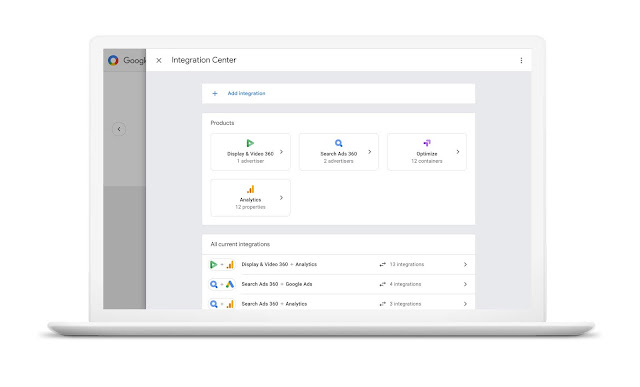
Now, with Google Marketing Platform, we’re introducing ways to make our products work even better together. For example, the new Integration Center helps you discover and easily setup valuable connections between products.
Google Marketing Platform also supports 100+ integrations with exchanges, measurement solutions, and other technology providers. In short, you can choose what media you buy, how you buy it, and how you measure it.

Search Ads 360 and Display & Video 360

With Google Marketing Platform, we’re also making changes to some of our advertising products.

Search Ads 360 is the new name for DoubleClick Search. Search Ads 360 will continue to help you plan, buy, and measure your search campaigns on Google and other search engines.

Display & Video 360 brings together features from our display advertising products: DoubleClick Bid Manager, Campaign Manager, Studio and Audience Center. Display & Video 360 allows you to execute ad campaigns end-to-end in one place, creating efficiency in how you work and helping your teams do more together.

Don’t worry, Campaign Manager and other DoubleClick products aren’t going anywhere right away. We’ll gradually transition customers to Display & Video 360 as additional features become available.

Looking ahead

This is just the beginning of the next chapter in our platforms story. We’re committed to building solutions that help you achieve your marketing goals while meeting consumers' high expectations for privacy, transparency and control.

We’ll be sharing more about Google Marketing Platform and Display & Video 360 at Google Marketing Live. Sign up to watch the live streamed keynote on July 10, 9:00 a.m. PT / 12:00 p.m. ET.

Posted by Brad Bender
Vice President of Display and Video Advertising

Posted:
We launched AdWords nearly 18 years ago with a simple goal—to make it easier for people to connect online with businesses. A search for eco-friendly stationery, quilting supplies, or for a service like a treehouse builder gave us an opportunity to deliver valuable ads that were useful and relevant in the moment. That idea was the start of our first advertising product, and led to the ads business we have today.

A lot has changed since then. Mobile is now a huge part of our everyday lives. People quickly switch from searching for products, to watching videos, browsing content, playing games and more. As a result, marketers have more opportunities to reach consumers across channels, screens and formats. The opportunity has never been more exciting, but it’s also never been more complex. Over the years, Google ads have evolved from helping marketers connect with people on Google Search, to helping them connect at every step of the consumer journey through text, video, display and more.

That’s why today we are introducing simpler brands and solutions for our advertising products: Google Ads, Google Marketing Platform, and Google Ad Manager. These new brands will help advertisers and publishers of all sizes choose the right solutions for their businesses, making it even easier for them to deliver valuable, trustworthy ads and the right experiences for consumers across devices and channels. As part of this change, we are releasing new solutions that help advertisers get started with Google Ads and drive greater collaboration across teams.

Google AdWords is becoming Google Ads

The new Google Ads brand represents the full range of advertising capabilities we offer today—on Google.com and across our other properties, partner sites and apps—to help marketers connect with the billions of people finding answers on Search, watching videos on YouTube, exploring new places on Google Maps, discovering apps on Google Play, browsing content across the web, and more.
For small businesses specifically, we’re introducing a new campaign type in Google Ads that makes it easier than ever to get started with online advertising. It brings the machine learning technology of Google Ads to small businesses and helps them get results without any heavy lifting—so they can stay focused on running their businesses. To learn more, visit this post.

We'll introduce more new campaign types at Google Marketing Live. Sign up to watch the livestream on July 10th.

Stronger collaboration with Google Marketing Platform

We’re enabling stronger collaboration for enterprise marketing teams by unifying our DoubleClick advertiser products and the Google Analytics 360 Suite under a single brand: Google Marketing Platform.
We’ve heard from marketers that there are real benefits to using ads and analytics technology together, including a better understanding of customers and better business results. Google Marketing Platform helps marketers achieve their goals by building on existing integrations between the Google Analytics 360 Suite and DoubleClick Digital Marketing. The platform helps marketers plan, buy, measure and optimize digital media and customer experiences in one place. To learn more, visit the Google Marketing Platform blog.

As part of Google Marketing Platform, we’re announcing Display & Video 360. Display & Video 360 brings together features from DoubleClick Bid Manager, Campaign Manager, Studio and Audience Center to allow creative, agency, and media teams to collaborate and execute ad campaigns end-to-end in a single place. We’ll share more details about Display & Video 360 in the coming weeks, including a demo during the keynote at Google Marketing Live.

Google Ad Manager: A unified platform

We recognize that the way publishers monetize their content has changed. With people accessing content on multiple screens, and with advertisers’ growing demand for programmatic access, publishers need to be able to manage their businesses more simply and efficiently. That’s why for the last three years, we’ve been working to bring together DoubleClick for Publishers and DoubleClick Ad Exchange in a complete and unified programmatic platform under a new name–Google Ad Manager.
With this evolution, we’re excited to do even more for our partners—earning them more money, more efficiently, wherever people are watching videos, playing games or engaging with content, and however advertisers are looking to work with them. To learn more, visit the Google Ad Manager blog.

Transparency and controls people can trust

We know that the media and technology advertisers and publishers choose to use impacts the relationships they have with their customers. As always, our commitment is to ensure that all of our products and platforms set the industry’s highest standard in giving people transparency and choice in the ads they see. For example, we recently announced new Ads Settings and expanded Why this ad? across all of our services, and almost all websites and apps that partner with us to show ads.

You'll start to see the new Google Ads, Google Marketing Platform and Google Ad Manager brands over the next month.

We’ll be sharing more about these changes—and many other new Ads, Analytics and Platforms solutions designed to help you grow your business—at Google Marketing Live. Register now to watch live on July 10, 9:00 a.m. PT / 12:00 p.m. ET.

Posted by Sridhar Ramaswamy
Senior Vice President, Ads & Commerce

Posted:
We are excited to announce that audio ads are now available to all DoubleClick Bid Manager customers globally. As one of the most immersive and accessible mediums, audio offers exciting new terrain for brands to reach an engaged audience. It’s estimated that in 2018 1.2B people will use music streaming services globally1.

Bid Manager now offers you the tools you need to reach this massive audience across a number of the most popular streaming services. Marketers can access ad inventory from Google Play Music, Spotify, SoundCloud and TuneIn — with Pandora coming soon. Using Bid Manager to buy audio ads offers brands the opportunity to bring audio and digital campaigns together in one place, helping you connect with users in various moments throughout the day.

“We are thrilled to see DoubleClick embracing programmatic audio. This launch makes it possible for Bid Manager customers to reach Spotify’s highly engaged audience across video, display and audio formats.”
- Zuzanna Gierlinska, Head of Programmatic, Europe at Spotify

Programmatic audio ads drive results

The new audio ad capabilities arrive at a time of growing buyer demand for tailored audio solutions. Research from WideOrbit shows that 85% of US radio buyers are interested in buying audio ads in real-time to better reach their core consumers. Over half of US radio buyers believe that buying audio ads programmatically streamlines workflows and 75% believe it provides the benefits of real-time optimization and reporting2.

DoubleClick customers are already seeing success with programmatic audio strategies. MightyHive used Bid Manager to access audio ads on Google Play Music, expanding the reach of its radio campaign. This strategy enabled the company to uncover new audiences for its Consumer Packaged Goods (CPG) client and deliver over 7.5 million impressions and over 7,500 clicks across mobile web, desktop and app. With Bid Manager, MightyHive was able to find and reach their desired audience. The campaign achieved ad completion rates over 95% and drove a CTR of 0.11%.

“Audio advertisements have long been an effective means to reach customers. Updating these ads for a programmatic world represents yet another significant step forward for our industry — creating opportunities to engage users in the right moments between screens. MightyHive is thrilled to be a pioneer in introducing this format to our clients.”
- Pete Kim, CEO, MightyHive

Connect with your customers and break through the noise

Audio ads bought through DoubleClick help brands connect with people even when they aren’t engaged with the screen on their device. In these moments when they are listening to audio, people aren’t overwhelmed with multiple ads, meaning that brands who are present get higher share of voice.

"As a company whose foundation is in audio, we deeply understand the medium’s impact and recognize why it has quickly become the most personalized way for brands to connect with their audiences - including our own highly engaged and influential community of tastemakers. SoundCloud is thrilled to be working closely with DoubleClick at the forefront of the development of their audio programmatic solution. This is a huge milestone for the digital marketing industry and for the evolution of audio advertising."
- Chris Blackburn, Head of Global Sales and Partnerships, SoundCloud

Audio advertising will continue to grow as music streaming services attract more users, and more consumers turn to audio for entertainment across devices. Given these trends, it’s clear that brands should invest in reaching consumers with the right messages in audio just like they do in every other medium. Buying audio ads through DoubleClick Bid Manager is a great place to start.

To learn more, reach out to your DoubleClick account representative.

Posted by Jean-Claude Homawoo
Product Manager, DoubleClick

1 Statista “Digital Market Outlook: users of digital music worldwide 2016-2022
2 WideOrbit Survey “The Future of Programmatic Radio Advertising”, September 2017

Posted:
Sign up to join the live streamed keynote at Google Marketing Live:

When: Tuesday, July 10, 2018 at 9 a.m. PT / 12:00 p.m. ET

Duration: 1 hour

Where: Here on the DoubleClick Advertiser Blog
It’s that time of year again! Join us as we unveil the latest Ads, Analytics and Platforms innovations at Google Marketing Live. Get a first look at new features and tools that will help you transform your business. Also gain access to the latest insights and trends that are shaping the future of the industry.

Register for the keynote live stream here. We’ll also make a recording available after the live stream for advertisers in other time zones.

Until then, subscribe to Think With Google, and follow us on Twitter, Google+, Facebook and LinkedIn for a sneak peek of what’s coming soon.

Posted by Sridhar Ramaswamy
Senior Vice President, Ads & Commerce

Posted:
Consumers engage with your brand across many channels, from search to display to social. However, only 17% of advertisers look at performance across these channels.1 And while search advertising will continue to make up the majority of digital ad spend this year, spending on social ads is estimated to grow. That’s why we’ve expanded DoubleClick Search’s best-in-class cross-channel reporting and optimization to include social ads. Key features include:

Automated click and view tracking

We’ve partnered with social marketing platforms, including 4C Insights and Smartly.io, to make integration simple. Once you connect your account, DoubleClick’s view and click trackers are automatically applied. You’ll be able to see your Floodlight-based conversion metrics, including visits, actions, transactions and revenue in your social reports. In the coming weeks, we’ll be expanding support to include Brand Networks and Sprinklr.
Connect to top paid social marketing platforms
If you’re not using a social marketing platform, you can use tracking sheets to see your social ads activity directly in DoubleClick Search.
“DoubleClick Search streamlined the process of connecting our DoubleClick click and view trackers to our social campaigns. We’ve saved upwards of 6+ hours a month in trafficking, while still being able to leverage attribution insights in DoubleClick Campaign Manager.”
— Andi Brosseuk, Team Lead, iProspect Canada

Unified reporting across channels

See your search, social and display data all in one place. With a connected social account, your clicks, conversions, impressions and cross-channel remarketing metrics are captured together with your other channels.

Using different tracking tags across channels often results in splintered and duplicated data. To ensure you don’t overvalue clicks or channels, DoubleClick Floodlight tags deduplicate conversions across search, display and social. You can also report on assisted conversions, which tells you the number of conversions that were assisted by a particular keyword or ad.
See your search, display and social data together

Unified cross-channel attribution

Assign credit to the right customer interactions across channels by using a single attribution model. Then use Smart Bidding to automatically set bids informed by your cross-channel attribution model for even better performance.

You can also include social data in your DoubleClick Campaign Manager path-to-conversion reports to understand the role your social ads play in your customers’ path to purchase. For example, if you see that most of your sales happen after multiple clicks on your social ads, there might be an opportunity to refine your social ad content.

Cross-channel remarketing

Drive more conversions by creating an audience in one channel, and reaching them on another. For example, reach qualified shoppers on Google.com with an engaging search ad after they’ve clicked on an awareness-building social ad. You can re-engage these social audiences on both search and display.
“As an agency, we’re excited to integrate our social campaigns into DoubleClick Search. The ability to share remarketing lists across channels has not only improved our performance, but also enabled our cross-channel teams to work more closely together. We’re now also able to see more of the conversion path in DoubleClick Search, including the addition of social conversions into our Data Driven Attribution models.”
–Beth Williams, Search Platforms Lead, Merkle Periscopix
Learn more about integrating your paid social campaigns in the DoubleClick Search Help Center.

Posted by Sriram Parameswar
Product Manager, DoubleClick Search

1 Source: Advertiser Perceptions/Google, Measurement Survey, U.S., September 2017

Posted:
In May, Europe’s new General Data Protection Regulation (GDPR) comes into effect. Google is committed to complying with the GDPR, and in preparation, we’ve been working with our customers and partners to inform them about changes we’re making to our policies across our various products.

Today we’re informing advertisers and publisher partners about changes to our ad policies. Google already requires publishers and advertisers using our advertising services to get consent from end users to use our services, as required under existing EU law. However, the GDPR will further refine these requirements.

To comply, we will be updating our EU consent policy when the GDPR takes effect and the revised policy will require that publishers take extra steps in obtaining consent from their users. Before May, we will launch a solution to support publishers that want to show non-personalized ads, and we are working with industry groups, including IAB Europe, to explore proposed consent solutions for publishers.

We’re aware that our customers and partners - European and international - have significant obligations under these new laws, as does Google. Publisher and advertiser partners can expect further updates as we approach the date when GDPR takes effect.

Posted by Carlo D’Asaro Biondo
President, EMEA Partnerships

Posted:
The way we watch TV has fundamentally changed. The popularity of on-demand and over-the-top streaming services, the proliferation of devices, and the availability of more high-quality content means that we’re able to watch wherever, whenever and however we want.

While this is great for consumers, it can create complexity for marketers. But there is also opportunity — you can now use advanced data and automated technology to more effectively reach audiences wherever they are choosing to watch.

We’ve launched a new guide for marketers that is all about that opportunity. Learn what TV and video viewing behavior looks like in today’s world and get recommendations for how to apply data and automated technology to reach viewing audiences more effectively.

Then, get started today with our 10 best practices for improving your DoubleClick brand campaigns.


Posted by Becky Chappell
Product Marketing Manager

Posted:
With DoubleClick’s Programmatic Guaranteed solution, advertisers and media owners can transact both reservation and open auction media buys programmatically, using a single platform. This means advertisers get one view of all their buys across a campaign, allowing them to more effectively control reach and frequency so they get better results. And advertisers and media owners each benefit from a simpler and more efficient workflow.

We worked with Nielsen and the Boston Consulting Group (BCG) to quantify the benefits of this technology for advertisers, agencies and media owners.

Across 10 global campaigns, we found that the consolidated ad buying approach offered by Programmatic Guaranteed drove an 11% increase in reach efficiency. This means that marketers in the Nielsen study reached 11% more unique consumers -- without increasing their campaign investment -- when using Programmatic Guaranteed, compared to a siloed approach where reservation and open auction buys were managed separately.1

Buyers and sellers also save significant time when using Programmatic Guaranteed: from insertion order to billing, agency marketers in the BCG study spent 30% less time on set-up and ongoing management of campaigns compared to traditional reservations. Media owners in the BCG study spent 57% less time on set-up and ongoing management of Programmatic Guaranteed campaigns compared to traditional reservations.2

To learn more about the results, make sure to download the full report.

1 Results based on a Google commissioned study conducted by Nielsen. The siloed media buying portion of the test reached on average 322,575 unique consumers for each million impressions compared to the consolidated media portion that reached 359,617 unique consumers.

2 Results based on Google commissioned study conducted by The Boston Consulting Group, “A Guaranteed Opportunity in Programmatic”, February, 2018.
Posted by Andrea Vassalli
Product Marketing Manager

Posted:
With the Big Game around the corner, brands will soon be debuting their highly anticipated 2018 TV spots. In recent years, we’ve seen marketers adopt a number of strategies across TV and digital to drive brand awareness around the event, from uploading their videos early to YouTube to promoting mobile apps and social hashtags in their commercials during the game.

Today, we’re introducing two new features in DoubleClick Bid Manager that help marketers effectively coordinate their TV and digital campaigns and ensure their message lands during big cultural and real-world moments.

Sports fans are engaging across screens

Cross-screen brand strategies are critical to success, because today’s sports fans are engaging with content across devices more than ever. In a recent study, Ipsos found that 80% of sports viewers say they use a computer or smartphone while watching live sports on TV, to do things like searching for player stats and live scores, messaging other fans, and watching related videos. 1

To reach a broad, engaged audience of sports fans, marketers need to complement their live TV commercials with coordinated messages across digital devices.


Reach audiences around real-world events

Real-time triggers is a new, easy-to-use workflow now available as a beta* in DoubleClick Bid Manager. It allows advertisers to activate display and video campaigns in real-time, based on pre-defined “triggers” or moments that correspond with an event on live TV or in the real world.

Brands define the triggers they care about in Bid Manager and then specify which ad creative they want to go live immediately following that event. For example, during a live televised event, an advertiser might trigger digital video ads to serve right after their commercial airs on TV. These ads could promote a lower-funnel action like an app download or a store visit, or they could promote the new spot that just aired and drive people to watch it again on YouTube. In this way, the brand can extend the reach and impact of their TV campaign by bringing their message to sports fans who may be engaging on second-screen devices.

The real-time triggers workflow makes event-based campaigns scalable and easy to build: set campaigns up ahead of time by selecting the trigger type, defining the moments you care about, and specifying the ads you’d like to serve following that trigger. Bid Manager will then serve your ads automatically when your defined moment occurs.

Key to this new capability is that it’s nearly instantaneous from the time the moment occurs to the time your campaign goes live -- we’ve gotten our serving speed down to just a few seconds so you can provide true real-time coordination between live events and digital campaigns.

In addition to live TV data, we’ve integrated weather data so that advertisers can serve ads based on real-time weather parameters (e.g. when it starts to rain, serve ads for umbrellas). We’ll also be launching sports triggers so that advertisers can serve ads based on real-time occurrences in sporting events (e.g. when a player scores in the game, immediately serve congratulatory ads across devices). This will be particularly useful for all the exciting sports events happening this year.


Measure traditional TV campaigns alongside your digital reporting

Real-time coordination of TV and digital campaigns is important for reaching audiences across screens. But it’s also important for buyers to be able to measure their TV campaigns alongside their digital ones.

Access to TV metrics can help digital buyers better understand how TV dollars are working to reach their audiences. They can then use these insights to better plan and coordinate their digital campaign budgets and tactics.

We’re giving digital buyers access to linear TV campaign data directly in Bid Manager, through a new reporting dashboard called TV Ad Explorer (available in beta*). This launch builds on our efforts to make linear TV buying and impact-based measurement available in Bid Manager.

With TV Ad Explorer, you can immediately begin to explore the metrics from your recent TV campaigns, whether you bought the media through Bid Manager or not. Google collects minute-by-minute ad airings data from standard broadcast sources and partners in a privacy-safe way. This data enables advertisers to see airings data as soon as a day after airing, as well as measure the reach of their TV ads by daypart, demographics, genres, networks and shows.

TV Ad Explorer can help answer questions such as “Did my TV campaign deliver against the intended target?” and “On which shows or content did my TV campaign index heavily?” Brands can use the answers to these questions to inform their digital campaign tactics. Brands can also look at their TV campaign performance around big events from previous years and use those insights to inform creative and media decisions around the same events in the future. In addition to standard TV metrics, digital metrics such as Brand Interest (the change in volume of searches for a brand after an ad airs) will be incorporated into TV Ad Explorer to provide additional information for buyers to measure the impact of their TV ads.

In the future, we plan to enable media planning across TV and digital, so advertisers can leverage insights from their TV campaigns to optimize their digital media plans. For example, advertisers will be able to use TV Ad Explorer to project if and how digital media placements can provide incremental reach or more cost-efficient reach to augment TV.

The way people watch video content has changed. As an advertiser, it's not enough to worry about just one screen anymore. To really break through and ensure your message sticks, you need to connect with people across all the content and screens they are choosing. Today’s launches advance our efforts to help advertisers bridge the gap between TV and digital.

1Google/Ipsos Connect, Sports Viewing Survey, US, December 2017 (n of 1,520 adults aged 18 to 54 who identify themselves as sports fans. Average across 10 sports.)

*The availability of TV Ad Explorer and Real-time triggers varies across regions depending on the type of data and inventory you’re using. Please talk to your DoubleClick Sales rep to understand what is available for your region and campaign type.


Posted by Jean-Claude Homawoo
Product Manager, DoubleClick

Posted:
Remarketing lists are a great way to reconnect with previous visitors to your website. They can also provide valuable customer insights that can be used to find new opportunities to help you reach your goals. However, due to the number and size of your lists, these insights can often be difficult to identify.

With adaptive remarketing, DoubleClick Search will automatically find those opportunities and create more focused remarketing targets to help you reach visitors who are interested in other products and services you offer.

Get more out of your remarketing lists

Adaptive remarketing is easy to use. Simply enable “remarketing targets” under Adaptive settings in your campaign settings page after applying a Smart bidding strategy or conversion goal. DoubleClick Search will then continuously compare the conversion rates of your remarketing lists against the conversion rates of the campaigns they’re applied to. Whenever a list has a conversion rate that varies significantly from its campaign, a new remarketing target will be created so you can set optimal bid adjustments.

For example, let’s say you’re a travel advertiser with a campaign for vacations in Chicago. You know you’re reaching people who’ve shown interest in traveling to Chicago, however you might not realize that conversion rates for Chicago may be higher for audiences who’ve previously shown interest in other cities.

By comparing performance, adaptive remarketing sees that many people who purchase Chicago vacations are the same ones who’ve shown interest in San Francisco vacations. As a result, your 'San Francisco' remarketing list would be automatically applied to your Chicago campaign, allowing you to easily adjust your bids for these customers to drive more revenue.
You can apply adaptive remarketing in your campaign settings

Get better results with Smart Bidding

DoubleClick Search Smart Bidding automatically finds the optimal bid to get you the best return on investment (ROI). By combining adaptive remarketing with Smart Bidding, you can enjoy even more benefits from automation.

When you apply a bid strategy or conversion goal to your adaptive campaign, we’ll continuously assess existing and auto-generated remarketing targets to align with your goal. Using the previous example, Smart Bidding will automatically adjust bids for your ‘San Francisco’ remarketing targets and ensure that your bid adjustments are always optimized.

Learn more about how adaptive remarketing can help you uncover business opportunities in the DoubleClick Search Help Center.

Posted by Amit Varia
Product Manager, DoubleClick Search

Posted:
From buying a TV to planning a holiday vacation, it takes consumers, on average, four clicks before completing a transaction online.¹ Some of these clicks matter more than the others, yet 40% of businesses still use first-touch or last-touch attribution when measuring ad performance.²

In order to understand the true value of each of those clicks, you need an attribution model that better reflects the new fragmented mobile-first consumer journey. Data-driven attribution (DDA) in DoubleClick Search solves this by helping you better understand the value of each ad click throughout your customer’s journey.

Create a model that fits your needs

Machine learning sets DDA in DoubleClick Search apart from rules-based attribution models. Unlike those models, DDA calculates the value of each ad click using your Floodlight conversion data, including conversions that happen across devices and browsers. By looking at all the clicks that happen across all those conversions, DDA can assign more value to the clicks that are driving conversions, and less value to those that don't.

Over time, your model will become more accurate as more data becomes available to inform your bids with. You can also customize your DDA model to fit your business goals.

DDA gets results

Here’s how DDA has already created value for advertisers around the world:


“Data-driven attribution has taken our campaign performance to the next level. By creating tailored attribution models for both new and existing customer journeys, we’re able to easily see which campaigns are contributing to our chosen business objective,” says Matt Darbon, Online Marketing at Waitrose. The British supermarket chain decreased its cost-per-order by nearly 40% while significantly increasing sales volume.


Walks of Italy provides immersive tour experiences around Italy's major cities and attractions. Using DDA and Smart Bidding, the brand saw a 31% increase in ticket sales, compared to 11% for other non-brand campaigns not running on DDA bid strategies. It also saw 25% growth in overall return on investment (ROI).


Volkswagen Group, one of the world’s leading vehicle manufacturers, saw sales leads increase by nearly 6% and cost-per-lead decrease by 17% in Brazil with DDA.


TalkTalk, the UK’s leading value-for-money telecoms provider, partnered with mSix to implement DDA for its campaigns. As a result, the brand saw its total volume of sales increase by 9% while maintaining its cost-per-acquisition.


Make DDA work for your business

Here are some best practices to help ensure your data-driven attribution models are customized to meet your business goals:

  • Apply your customer and market knowledge. Create and apply DDA specific labels to your campaigns based on the role that Search activity plays in the customer journey. Learn more
  • Check the accuracy of your model with Floodlight columns. Once you’ve created your custom DDA model, create Floodlight columns for DDA conversions to ensure your model is set up correctly. Learn more
  • Track your performance against other models. For easier monitoring, add your DDA model to your favorite reports. Create a custom column that shows the percentage difference in conversion value assigned to keywords, campaigns and labels between your attribution models. Learn more
  • Re-evaluate keywords, campaigns and labels for performance. Now that you’re measuring the value of every click, you may discover that some of your campaigns are performing better than before. Make sure your budget and bids are updated based on the insights provided by DDA. Learn more
  • Automate your bids based on your new model. To get the full benefits of DDA, use Smart Bidding with your DDA model to automatically set optimal bids across your campaigns. Learn more

Learn more about data-driven attribution in the DoubleClick Search Help Center.

¹ Google Analytics MCF data for single device measurement, Feb. 2017
² Google/Forrester, "Cross Channel Attribution is Needed to Drive Marketing Effectiveness," May 2014, U.S.
Posted by Michel van Luijtelaar
Measurement & Attribution Specialist, DoubleClick Search

Posted:
Advertising should be free of invalid activity – including unauthorized, misrepresented, and fake ad inventory – which diverts revenue from legitimate publishers and tricks marketers into wasting their money. Earlier this year we worked with the IAB Tech Lab to create the ads.txt standard, a simple solution to help stop bad actors from selling unauthorized inventory across the industry. Since then, we’ve shared our plans to integrate the standard into our advertiser and publisher advertising platforms.

As of November 8th, Google’s advertising platforms filter all unauthorized ad inventory identified by published ads.txt files:
  • Marketers and agencies using DoubleClick Bid Manager and AdWords will not buy unauthorized impressions as identified by publishers’ ads.txt files.
  • DoubleClick Ad Exchange and AdSense publishers that use ads.txt are protected against unauthorized inventory being sold in our auctions.

Preventing the sale of unauthorized inventory depends on having complete and accurate ads.txt information. So, to make sure our systems are filtering traffic as accurately as possible, we built an ads.txt crawler based on concepts used in our search index technology. It scans all active sites across our network daily, over 30m domains, for ads.txt files, to prevent unauthorized inventory from entering our systems.


The adoption of ads.txt has been growing quickly and the standard is reaching scale across publishers:
  • Over 100,000 ads.txt files have been published
  • 750 of the comScore 2,000 have ads.txt files
  • Over 50% of inventory seen by DBM comes from domains with ads.txt files

We believe ads.txt is a significant step in cleaning up bad inventory and it's great to have the broad support of our partners like L’Oreal, Omnicom Media Group, and the Financial Times.
“Consumers place enormous value on the ability to trust brands, which is why transparency in advertising is a top priority at L’Oreal. We look forward to collaborating with Google on this initiative as we continue to encourage the industry to follow suit.”
- Marie Gulin-Merle, CMO L’Oreal USA
"Removing counterfeit inventory from the ecosystem is critical to maintaining trust in digital. The simple act of publishing an ads.txt file helps provide the transparency we need to quickly reduce counterfeit inventory from harming our clients."
- Steve Katelman, EVP Global Strategic Partnerships, Omnicom Media Group
“It's great to see adoption of ads.txt across the industry and we're happy to see Google put their support behind this initiative. By eliminating counterfeit inventory from the ecosystem, marketers' budgets will work that much harder and revenue will reach real working media to fund the independent, high-quality journalism which society depends upon."
- Anthony Hitchings, Digital Advertising Operations Director, Financial Times

It’s amazing to see how fast the industry is adopting ads.txt, but there is still more to be done. Supporting industry initiatives like ads.txt is critical to maintaining the health of the digital advertising ecosystem. That’s why we’ll continue to invest and innovate to make the ecosystem more valuable, transparent, and trusted for everyone.

Posted by Per Bjorke
Product Manager, Google Ad Traffic Quality

Posted:
With the all important holiday shopping season about to begin, you can’t afford to miss any revenue opportunity. But you also need to be careful about how much you push your already stretched team. This is why we recently introduced three new tools, available to all DoubleClick Bid Manager accounts, that will help you reach more consumers while reducing manual work.

Expand your reach

First, as part of the new planning workflow in DoubleClick Bid Manager, we recently launched a new campaign object that lets you group Insertion Orders (IOs), so you can more efficiently manage your ad buys. For example, this will help you improve the reach of your campaign by allowing you to set up frequency capping across Programmatic Direct deals and open auction IOs, so you can be sure that your open auction campaigns reach consumers who haven’t been already exposed to your ads. You can create a new campaign in just a few simple steps*.

Second, we have introduced a slider that lets you expand your similar audience lists* so you can choose if you want maximum reach, higher similarity or a balance of the two. For example if you’re a toy retailer, your sales during the holiday season are likely going to be critical in determining your success for the entire year. To capture the increased holiday demand, you can use the slider to choose to reach the most possible consumers who look like your frequent purchasers. Once the sales peak has passed, you can scale your similar audience campaigns back to focus on more similarity.

You can find the new expansion slider in the Audience lists targeting tab of your line item level settings.

Optimize campaigns faster

By following the steps above, you can improve the setup of your campaigns and give them the best chance of success, but once your campaigns are up and running, you need a fast way to spot if things are not going according to plan. To help you with this, we recently introduced a new optimization view that allows you to quickly focus on campaigns that are not on track to achieve their spend and performance goals.

Once you know where you should focus your attention, you’ll be able to quickly determine what is driving the poor performance. By segmenting the data along dimensions (site, time of day, day of week, environment and more), you can easily see what is impacting performance.

In addition to surfacing key insights, the optimization view also provides suggestions on how you could optimize Line Item budgets within an IO. This way you can spend time making strategic decisions and not calculating how you should re-allocate budget across different Line Items.


Since using the new optimization view, our partner OMD Australia has been getting more granular insights faster:

"The optimization view has been helping us get quick insights, such as top performing placements and times of day. With this information we can immediately change our strategies to boost campaign performance without having to manually pull reports."
- Jiff Kumar, Programmatic Trader at OMD Sydney

You can access the new optimization view* at the IO or Line Item level by selecting Optimization from the drop down menu next to the New Insertion Order or New Line Item buttons in the DoubleClick Bid Manager.

Posted by Deirdre Athaide and Rod Lopez
Product Managers, DoubleClick Bid Manager


*A DoubleClick Bid Manager account is required to visualize the article.

Posted:

Cross-posted from the Google Analytics blog

We often hear from marketers how challenging it is to piece together online and offline customer interactions in order to see a complete view of a customer’s journey. That’s why we’re excited to share that Google and Salesforce are working together to seamlessly connect sales, marketing and advertising data for the first time, giving you the full view of what’s working and what isn’t as customers engage with your ads, websites, apps, emails, call centers, field sales teams and more.

Today at Dreamforce, Google and Salesforce are announcing a strategic partnership to deliver four new, turnkey integrations between Google Analytics 360, Salesforce Sales Cloud and Salesforce Marketing Cloud:
  • Sales data from Sales Cloud will be available in Analytics 360 for use in attribution, bid optimization and audience creation
  • Data from Analytics 360 will be visible in the Marketing Cloud reporting UI for a more complete understanding of campaign performance
  • Audiences created in Analytics 360 will be available in Marketing Cloud for activation via direct marketing channels, including email and SMS
  • Customer interactions from Marketing Cloud will be available in Analytics 360 for use in creating audience lists

These new connections between our market-leading digital analytics solution and Salesforce’s market-leading customer relationship management (CRM) platform will change the game for how our clients understand and reach their customers — and how they measure the impact of their marketing. These integrations are fully consistent with our privacy policies and have settings that offer privacy controls and choice on how data is used.

By integrating your customer data, you can see a customer’s path from awareness all the way through to conversion and retention. And with connections to Google’s ad platforms and Salesforce’s marketing platform, you can quickly take action, engaging them at the right moment. You'll see these new integrations begin to arrive in the first half of 2018.

Example of a complete customer journey funnel in Google Analytics 360 joining website data (pageviews, leads submitted) with pipeline data from Sales Cloud (lead and opportunity stages); example also shows a prompt to create a new audience segment to take action

New insights

Until now, businesses have not been able to connect offline interactions, such as an estimate provided by a call center rep or an order closed by a field sales rep, with insights on how customers use digital channels. With the connection between Sales Cloud and Analytics 360, soon you’ll be able to include offline conversions in your attribution modeling when using Google Attribution 360, so you’ll have a more complete view of ROI for each of your marketing channels and even more reason to move away from a last-click attribution method. This integration will also let you see how your most valuable customers engage with your digital properties, answering some important questions like, what are they looking for and are they actually finding what they need?

With the integration allowing data from Analytics 360 to be visible in Marketing Cloud, you’ll gain a more complete understanding of how your marketing campaigns perform. For example, if you send an email campaign to frequent shoppers to promote your fall fashion line, you’ll be able to see right in Marketing Cloud information such as how many pages people visited when they came to your site, the number of times people clicked on product details to learn more, and how many people added items to their shopping cart and converted.

Easy to take action

Today, Google Analytics allows you to create audience lists and goals that you can easily send to AdWords and DoubleClick for digital remarketing and to optimize bids. With the new connection from Sales Cloud to Analytics 360, in addition to unlocking new insights and more data for attribution modeling, you’ll be able to combine Salesforce data (such as sales milestones or conversions) with behavioral data from your digital properties to create richer audiences and for smarter bidding.

For example, if you’re a residential solar panel company and want to find new customers, you can create an audience in Analytics 360 of qualified leads from Sales Cloud and use AdWords or DoubleClick Bid Manager to reach people with similar characteristics. Or, create a goal in Analytics 360 based on leads marked as closed in Sales Cloud, and automatically send that goal to AdWords or DoubleClick Search to optimize your bidding and drive more conversions.

With the Analytics 360 connection to Marketing Cloud, you’ll be able to use customer insights to take action in marketing channels beyond Google’s ad platforms, such as email, SMS or push notification. For example, you can create an audience in Analytics 360 of customers who bought a TV on your site and came back later to browse for home theater accessories, and use that list in Salesforce to promote new speakers with a timely and relevant email.

Powerful combination

Every day, Google Analytics processes hundreds of billions of customer moments, Salesforce Marketing Cloud sends 1.4 billion emails, and there are over 5 million leads and opportunities created in Salesforce Sales Cloud. These new integrations represent a powerful combination, and we believe they will help marketers take a big step closer to the ultimate dream: providing every customer with a highly relevant experience at each step of their journey.

You’ll see these new joint capabilities become available beginning in 2018, and we'll be sure to keep you updated along the way. Contact us here if you would like to learn more about Analytics 360. We hope you’re as excited as we are!

Posted by Babak Pahlavan
Senior Director of Product Management, Measurement & Analytics

The Google Analytics 360 + Salesforce integrations are just one part of a broader strategic alliance announced today between Google and Salesforce. Read about new integrations between G Suite and Salesforce and a new partnership between Google Cloud and Salesforce here.

Posted:
Measurement is foundational to digital marketing. Heading into the holidays, it’s more important than ever to make sure all of your online sales, reservations and leads are measured accurately. To that end, we wanted to bring an important update to your attention: the recent introduction of Intelligent Tracking Prevention affects conversion measurement on Safari. It’s important to update your website tags as soon as possible to support measurement of conversions from Safari. This is in line with Apple's recommendations for ad attribution. Without updating your tags, it will be difficult to measure the efficacy of your marketing campaigns.

Site-wide tagging preserves your visibility

There are multiple ways to measure the performance of your online advertising. The best options rely on site-wide tagging—tagging that’s applied to every page on your site. Applying the tag to every page of your site keeps your measurement updated and helps to measure conversions more accurately, including in Safari's ITP environment.

There are two options for complete measurement of conversions from Safari in DoubleClick Search:

Option 1: Install the global site tag (gtag.js) on your entire site

The global site tag (gtag.js) is a new web tagging library that works across Google's site and conversion measurement products–giving you better control while making implementation easier. The new tag will now serve as the single tag for both AdWords and Google Analytics, with support for DoubleClick Search coming mid-November. By setting it on every page of your site, and including event snippets on your active conversion pages, the global site tag will send conversion data whenever event calls are made.

Stay tuned to learn more about DoubleClick Search support for the new global site tag in November.

Option 2: Use Google Tag Manager

For customers who are already using Google Tag Manager, there's no need to make any changes to your page—simply add the Conversion Linker tag in the Tag Manager interface, and set it to fire on all pages.

If you're not using Google Tag Manager, you can get started today. Alternatively, you can start with the global site tag (option 1 above) and then easily upgrade to Tag Manager in the future.

If you’re using a non-Google tool for website measurement, check with your vendor to make sure your solution allows you to measure conversions in Safari's ITP environment.

Estimating untracked conversions in DoubleClick Search

To help you accurately measure and take action on your conversion data, DoubleClick Search uses statistical modeling. Statistical modeling gathers website conversions for traffic that can’t be measured from Safari and includes them in your DoubleClick Search reporting.

We’ll continue to use statistical modeling in Doubleclick Search where site-wide measurement isn’t applied. However, using site-wide tagging will let you better understand your marketing performance across all DoubleClick products.

Measurement in DoubleClick Campaign Manager and DoubleClick Bid Manager

The two options outlined above also provide more complete measurement of conversions in DoubleClick Campaign Manager and DoubleClick Bid Manager. You can use Google Tag Manager today and the new global site tag in mid-November. Campaign Manager and Bid Manager customers using these two measurement solutions will start to see improvements in measurement coverage over the next few months.

Posted by Sriram Parameswar
Product Manager, DoubleClick Search

Posted:
Advertising fraud is a complex challenge, but one that we are working to simplify for our partners. That’s why we’ve developed sophisticated systems, including over 180 automated filters and detection algorithms, to prevent invalid traffic from impacting our clients. For years, we’ve used these technologies to protect Google-owned media properties from invalid traffic and now we’re working to expand them to help the rest of the ecosystem.

Today we’d like to highlight three areas we are investing in, for DoubleClick Bid Manager, to help our partners build trust in the advertising supply chain.

Automating refunds for invalid traffic

In the coming months, we’ll be implementing new infrastructure to further automate the refund process for invalid traffic. Supply partners like AppNexus, Index Exchange, OpenX, Pubmatic, SpotX, Teads, Telaria and DoubleClick Ad Exchange have been very supportive of these changes and have committed to provide advertisers with refunds for invalid traffic detected up to 30-days after monthly billing.

“At OpenX, we believe it is the responsibility of every participant in the market to commit to providing a high quality, transparent and fraud free advertising marketplace. The industry must work together to advance a clean, well-lit ecosystem to be successful in eliminating the scourge of fraud from the market. We are pleased to partner with DoubleClick on this important effort to cut off funding for criminal actors and advance trust for our entire industry.”
- Ian Davidson, OpenX

These commitments, along with others, cover over 90% of the available inventory in DoubleClick Bid Manager. Soon, we’ll identify in Bid Manager which supply partners provide refunds for invalid traffic and offer advertisers the option to buy only from those sources. This will make it easier for our customers to collect refunds for invalid activity.

Increasing transparency on invalid traffic we’ve filtered

It’s hard to prevent invalid activity if you don’t know how you’re being impacted. That’s why we’re investing in reporting features to give advertisers and supply partners greater visibility into what our invalid traffic defenses detect.

With these new features, advertisers will be able to see and understand the amount of invalid traffic detected in their campaigns both pre-bid and post-serve, including breakdowns by categories like data center traffic, automated browsers, and falsely represented inventory. Supply partners will receive reporting on the sources and amounts of invalid traffic that our systems are post-serve filtering from their platforms. By providing our customers and supply partners with access to this data we hope to provide more transparency into the sources of invalid traffic, facilitate conversations with third parties, and make sure our clients’ media spend does not enrich bad actors.
Example of an upcoming change to our user interface showing the sources of invalid traffic.

Support for ads.txt

Beyond our own platforms, we are fully supportive of industry initiatives to improve the health of the advertising ecosystem and combat ad fraud. Recently, the IAB Tech Lab released the ads.txt standard to increase supply chain transparency and make it more difficult to sell counterfeit inventory. It defines a simple method for publishers to publicly declare who is authorized to sell or resell their digital advertising inventory.

We believe the ads.txt standard is a significant step forward in the fight against ad fraud, and by the end of October, DoubleClick Bid Manager will only buy a publisher’s inventory from sources identified as authorized sellers in its ads.txt file when a file is available.

The success of ads.txt will be defined by the extent of its adoption, and it’s great to see healthy adoption by publishers since the standard was finalized.

These changes are just some of the things we’re doing to help combat ad fraud and increase transparency in the advertising supply chain, and it’s been great working with partners like Nissan Motor Corporation, Omnicom Media Group and GroupM as we developed these solutions.

“Google has been a proactive partner helping us fight ad fraud. At Nissan, we look to Google, all publishers, as well as media agencies, to take their responsibility to clean up the inventory supply chain. It is therefore good to see that we’re gaining momentum to address this issue. We all need to embrace and demand new solutions to further accelerate this clean-up. That’s why we strongly urge all publishers we work with to adopt ads.txt to help keep the supply chain accountable and ensure marketer dollars are driving real results.”
- Roel de Vries, Nissan Motor Corporation

“We've always taken proactive steps to protect our clients from advertising fraud and we're glad Google is driving forward on this. These changes will help simplify the process of keeping invalid traffic out of our media buys and help clean up the ecosystem.”
- Steve Katelman, Omnicom Media Group

"We're extremely supportive of the steps Google is taking to bring transparency and accountability to the digital supply chain. It's critical that we have partners who are as dedicated as we are to protecting brands from ad fraud and we look forward to working together solve this issue for our clients."
-Rob Norman, GroupM

There’s no doubt that this is a complex problem, but if we continue to work together, we’re confident that we can address this challenge.

Posted by Payam Shodjai
Director, Product Management

Posted:
For an ad to have impact, being seen isn’t just important, it’s fundamental. That’s why measuring the viewability of advertising matters so much. Today, we’re releasing new research to help the industry better understand video ad viewability rates around the world and across devices, and announcing updates to our Active View measurement technology that helps advertisers place their ads where they have a better chance to be seen.

The current state of video ad viewability

Last year, we announced that globally, average video ad viewability on YouTube grew to 93%, significantly higher than the 66% average video ad viewability across the rest of the web and apps. Today, this number is even higher: Globally, average YouTube video ad viewability is now 95%, while the average video ad viewability across the rest of the web and apps remains at 66%.1 And what’s more, 95% of YouTube ads are audible.2

Read the full “State of Video Ad Viewability” report to see viewability rates across different inventory types and devices around the world.

New Active View optimization strategies in DoubleClick Bid Manager

To ensure all of your video ads are being seen and heard, not just those on YouTube, we’re launching two new Active View bid optimization strategies in DoubleClick Bid Manager for video ads on the rest of the web and apps, where video ad viewability is lower. This includes the ability to optimize towards a video ad that is viewable on screen for at least 10 seconds, or towards a video ad that completes in view and is audible.

Active View optimization uses machine learning to maximize the impressions that meet your viewability and audibility goals. Specifically, this means that Active View factors in signals like video player size, domain and position on page to determine the optimal bid for each impression, so you get the most from your marketing budget. These new bidding strategies allow you to improve view-through rate for situations when you need to know that your audience is paying attention — if, for example, you need more time to explain your offering, or if your branding or logo doesn’t show up until the end of the video.

These two new Active View bid optimization strategies are now available in Bid Manager for all advertisers globally, building on our existing Active View bid optimization strategies that help you deliver against viewable CPM goals.

Advanced Active View metrics for all of your video ads

Earlier this year we announced enhanced reporting for YouTube TrueView campaigns in DoubleClick. Now, we're expanding on that announcement and making new Active View metrics available in DoubleClick Campaign Manager and DoubleClick Bid Manager for all of your video ads, not just YouTube.

These new viewability and audibility metrics allow you to uncover deep insights into creative performance and user attention, including:

Studies have shown that the longer a user views your ad, the higher the lift in brand metrics like brand awareness and consideration. With new viewability and audibility metrics in DoubleClick, you can get closer to understanding which of your video ads are holding the attention of your viewers, and are thus most likely to make an impact, and which you need to improve in order to deliver more impact.

And, because DoubleClick Campaign Manager is MRC-accredited for viewable video ad impressions for desktop web, mobile web and mobile app, when you view these metrics in Campaign Manager you can feel confident that they’ve undergone a stringent, independent audit. We are also in the process of seeking MRC accreditation for video impressions and viewability statistics in both AdWords and DoubleClick Bid Manager.

Today’s announcements are the next evolution of Active View and reflect our commitment to empowering you with the data and tools you need to ensure your ads are capturing attention. Visit the Help Center to see all available metrics in Campaign Manager and Bid Manager reports.
Posted by Babak Pahlavan
Senior Director of Product Management, Analytics Solutions and Measurement, Google
Google and DoubleClick advertising platforms data, May 2017
Google Internal Data, Global, August 2016 (when volume is at least 10% for YouTube ads)