We've moved! Please subscribe to the Google Marketing Platform blog for updates


Posted:
This post is part of the with DoubleClick series, highlighting stories and perspectives from industry leaders about how they are succeeding with an integrated digital marketing platform.

KLM, one of the world’s largest airlines, serves over 20 million passengers each year. With 70% of these passengers outside of their home market, the Netherlands, digital marketing has given KLM the opportunity to reach their audience at scale, while at the same time personalizing their communication.

One of KLM’s main goals was to bring new visitors to their website to purchase plane tickets. They began using DoubleClick for programmatic buying in order to reach these prospects efficiently. “From the beginning, the advantages of bringing programmatic buying in-house were clear: transparency in the costs, control over the costs, and a much more effective campaign setup,” says Arjan Grootveld, Display Marketing Manager at KLM.
And they saw real uplift in efficiency over media spend. Grootveld told us, “If we look at our prospecting campaigns, if we compare pre- and post-programmatic, we see really see a decrease in costs.” At the same time, they were able to decrease CPA by 50%, and increase ROI by 200%.

The team at KLM is confident that programmatic buying has paved the way for innovation, and they see it as a huge enabler for the future.

To learn more about KLM’s approach and results, watch the video below:
You can stay on top of new updates by subscribing to our newsletter and following us on Google+ and Twitter.

Posted:

Marketers know that building cross-screen campaigns is important to overall campaign success. But many have been slow to adopt the HTML5 standards and mobile-compatible formats that are needed to achieve that success. 

Today, more than 25% of pageviews occur on a mobile device (1) and more people consume content in HTML5-compatible environments than Flash-compatible ones (2), yet 83% of digital creative is still built in formats that don’t work on mobile devices. (3)

The “Make Mobile Work” Initiative
To help marketers make the transition to cross-screen campaigns, we have partnered with the IAB for the past year on the “Make Mobile Work” Initiative. Through an open letter signed by 22 publishers globally, a mobile check-list for marketers, and a quarterly webinar series, we increased awareness of the need for cross-screen campaigns and provided the steps to successfully create, target and measure these campaigns. 

Positive momentum:
Efforts like this one appear to be working. Marketers’ trepidation toward mobile is beginning to melt away, as evidenced by strong growth metrics this year for HTML5 adoption and mobile inventory (metrics pulled from internal DoubleClick data, Nov. 2014):
  • 250% growth in HTML5 impressions in DoubleClick Studio 
  • 130% growth in the percent of DoubleClick Campaign Manager impressions being served to mobile devices
  • Almost half of the mobile inventory available in DoubleClick Bid Manager is now in-app inventory

Three easy-to-use tools for cross-screen campaigns
As marketers begin to incorporate cross-screen strategies into all of their campaigns, we want to make sure that every marketer has easy-to-use tools to help them scale. So we recently launched three new features in the DoubleClick Digital Marketing platform that make cross-screen creative, targeting and measurement easy to incorporate into every campaign:
  • Easy HTML5 creative: Our platform will automatically create an HTML5 version of every Flash banner you upload, with automatic Flash-to-HTML5 conversions for reservation campaigns (available in beta for programmatic campaigns). When your ads run on mobile devices, the interactive HTML5 ad will show up instead of a static backup image, helping expand your reach on mobile. You can also report on HTML5 impressions separate from Flash impressions. Learn More>>
  • Precise mobile targeting: For users who opt-in to location-based targeting, marketers can use Geofence Targeting in DoubleClick Bid Manager to deliver highly relevant messages to people based on their proximity to a specified chain store, across a broad geographic area. You can easily target all your store locations with a single click, enabling you to reach the right consumer and drive foot-traffic into your stores. For example, if you’re a hotel company, you can reach people who are close to your hotel, and offer them a discount to get them to choose your business. Learn more>>
  • Re-engage your app users: People are spending 86% of their time on mobile devices in applications. (4) DoubleClick now allows marketers to remarket to existing app customers inside other apps, for both reservations and programmatic buys. Using Floodlight tags, you can create audience lists around any engagement that takes place in-app (e.g. people who added an item to a shopping cart, top spenders in the last 30 days, or gold member app users). This lets you improve ROI by offering relevant ads to people who are already in the purchase funnel. Learn more>>

As 2015 approaches, we hope to see even more marketers incorporate cross-screen techniques, to successfully reach the right audiences on every device. 

Published by the DoubleClick Marketing Team

sources:
1. Mary Meeker’s Internet Trends Report, Apr. 2014
2. StatCounter Sept. 2013 data
3. Internal DoubleClick Data, Nov. 2014
4. Flurry Analytics Report, Mar. 2014

Posted:
This is our third post in a blog series on using real-time data to win in SEM. Today, we’re writing about the importance of real-time for product launches.

If you’re a marketer, a product launch can translate into a long list of to-dos - from updating your website with product, pricing, and promotional information, to setting up your campaigns for maximum exposure.

Then, you have to carefully monitor sales and respond to real-time changes in consumer demand. While some retailers receive and act on performance data after 24 hours, this lag can result in a significant lost opportunity for others. Real-time data helps you act in the first crucial minutes and hours of a launch.

Real-time data and the tools to act on it in DoubleClick Search can help make your launches a success. Automated bid strategies update bids multiple times per day to meet business goals. Up-to-the-minute conversion reporting means you can see sales as they come in, make adjustments, and ensure your changes are live across all engines as fast as you react.

Real-time becomes even more crucial in competitive markets when, for example, a single product is launching in numerous retail outlets at once. To illustrate this, we’ll use some examples from the mobile industry. With the release of the iPhone 6 and Moto 360 in September, and with pre-sales having opened for the Nexus 6 on October 29, autumn is a big launch season for mobile retailers. 

How important was real-time on these days? An example from the days following the iPhone 6 launch shows that DoubleClick Search responded to breaking trends throughout the day, and updated relevant advertisers’ bids an average of eight times, sometimes topping out at 13 bid changes per day during the highest-peak days. These frequent changes were made to drive incremental revenue or to push ads to the top of the page. Without DoubleClick Search’s real-time data and real-time bid strategies, these advertisers would have been left with their original bids for the whole day—missing out on opportunities for more sales.

But real-time is about more than just changing bids frequently. It is about knowing what is happening, like understanding what is and isn’t converting. During big events, the propensity for your keywords to convert can change dramatically. A big launch like one for the iPhone or Android generates many curiosity-seekers who - while not in-market - will be looking for information. Do these clicks matter for your business? Real-time conversion data shows you the answer, separating out keywords that drive revenue from those that just capture browsers, and distinguishing, in real-time, how they in relation to a big market event. With all of this real-time visibility available directly in your reporting, you can make quick decisions on whether you want to be in-market for non-converting keywords that may yet be important for your brand to stay out there. Automated bidding rules can make this even more responsive.

Jeffrey Mysel with Digitas LBi explains how real-time data was key for a successful launch and promotion of the Moto360 smart watch:

“Capturing demand for the Moto360 product launch was a crucial piece to our marketing program, and even more so for paid search. Having the benefit of real-time data gave us the flexibility to pulse our budget during important sales windows, as the team was able to monitor data and make adjustments on peak days. With DoubleClick Search, we were able to maximize our budget and make quick decisions to manage public demand, meet client needs, and keep our program in line with product inventory.” 


Real-time data can also be extremely useful for big seasonal events. As the holidays approach, our next post will highlight how DoubleClick Search clients used real-time data to take advantage of Black Friday and Cyber Monday this year.

Posted:
This post is part of the with DoubleClick series, highlighting stories and perspectives from industry leaders about how they are succeeding with an integrated digital marketing platform.

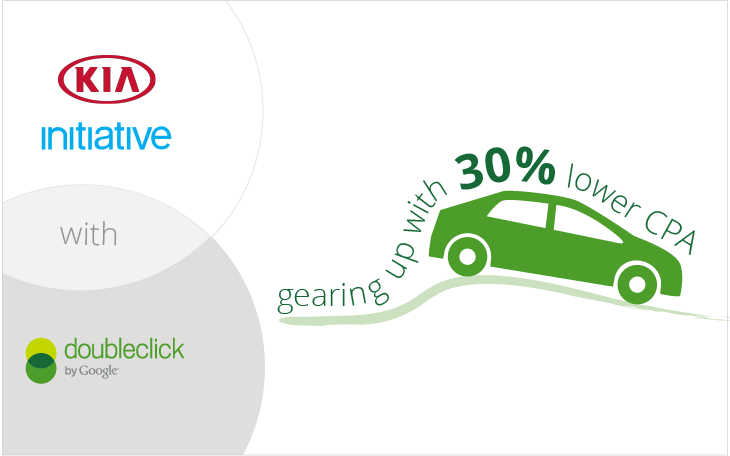
After more than a decade in the market, Kia has more than 200,000 cars on Australian roads. As the traditional path to purchasing cars has shifted toward digital, Kia needed a better way to understand its media mix and optimize its digital campaigns.

One of Kia’s main challenges was that its data was divided among multiple digital marketing platforms, each collecting different information about the same consumer. This made it difficult to understand the buyer’s behavior on the path to purchase. To tackle this problem, Kia and its media agency, Initiative, adopted DoubleClick Digital Marketing to manage all of Kia’s digital marketing efforts across search, display, video, and mobile.

Using one unified platform, the team was able to eliminate the multiple silos of data, remove reporting discrepancies, and develop a holistic view of the Kia customer. “The benefit of using DoubleClick is that we got a single reporting solution across all of our digital platforms,” says Simon Flaxman, Initiative commercial director.

With all data in one place, Kia and Initiative began taking advantage of the DoubleClick attribution tools to help them analyze every step of the customer journey, not just the last click. This allowed them to more accurately credit different publishers, channels, and screens. Using the Attribution Modeling Tool, they began testing various budget scenarios for individual publishers and channels, which was helpful for planning future sales cycles.
Since adopting the DoubleClick Digital Marketing platform, Kia has reduced its CPA by 30%. Today, Kia is focused on “winning in the middle” of the sales funnel, and doesn’t just look at the last click. It has the tools in place to accurately measure and gain insights into all of its digital activity, in real-time, on a single platform.

To learn more about Kia’s approach and results, watch the video below and check out the full case study here.

You can stay on top of new updates by subscribing to our newsletter and following us on Google+ and Twitter.